Leave Your Message


Choosing the right Crane Ceiling Rope starts with understanding the work it must perform. Overhead cranes lift steel coils, machine parts, and heavy loads through repeated cycles. Each lift places stress on the rope’s wires, core, and construction. A poor match may wear quickly, bend unevenly, or fail to provide the control a job requires.
This guide compares common rope types, including standard six-strand ropes, rotation-resistant constructions, compacted ropes, and ropes with different core designs. Each has trade-offs. A rotation-resistant rope can help control twisting, while a compacted rope may offer a smoother outer surface and improved wear characteristics. But no type suits every crane. The right choice depends on the reeving arrangement, sheave diameter, lifting frequency, environment, and manufacturer’s specifications.
Small details matter.
Before selecting a rope, check the crane manual, the existing rope’s construction, and the conditions around the drum and sheaves. Look for broken wires, corrosion, flattened sections, or uneven winding during inspection. These clues can point to fit or operating problems, though visual checks alone cannot settle every question. A qualified lifting-equipment professional should confirm any uncertain selection.
A named expert quotation could add useful context, but no verifiable source or expert statement was provided for this topic. Rather than invent an attribution, this introduction keeps the guidance grounded in practical selection factors. The sections ahead explain how the main Crane Ceiling Rope types differ, where each may be appropriate, and what to check before replacement. A rope is only one part of a lifting system. Its compatibility matters.
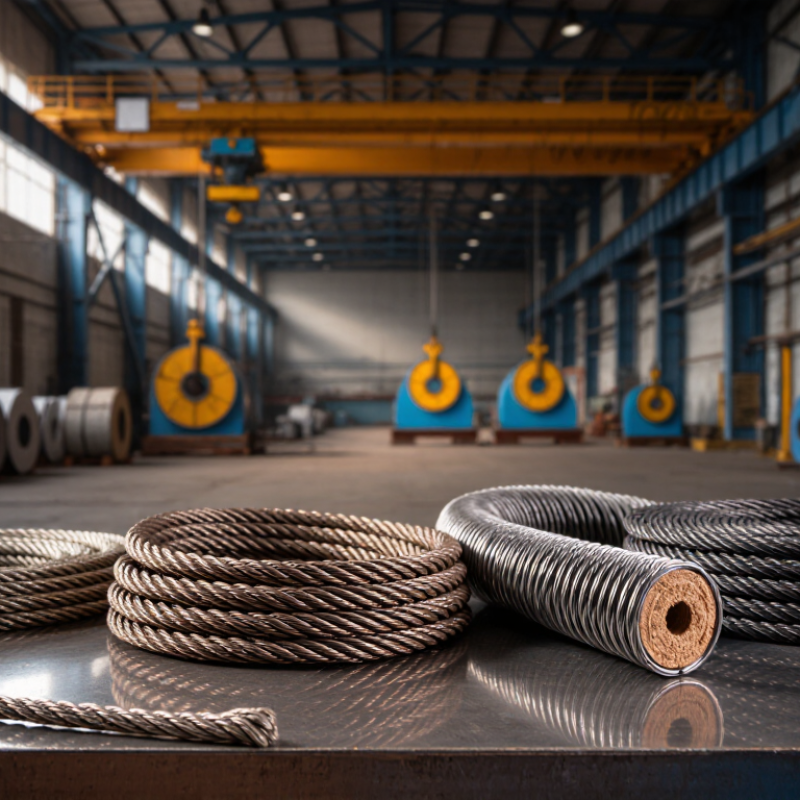
Overhead crane wire rope consists of steel wires twisted into strands and laid around a central core. Its construction affects flexibility, abrasion resistance, and how well the rope handles bending over sheaves. A 6×19 construction typically has fewer, thicker wires than a 6×36 design. That can improve wear resistance, while the 6×36 pattern is often more flexible. Actual performance depends on the specific rope design and operating conditions.
The core may be fiber or an independent wire rope core. A fiber core can offer flexibility, while a steel core generally provides greater support under heat and heavy loading. Rotation-resistant ropes use multiple strand layers arranged to reduce twisting under load. They can be useful on tall lifts, but require careful handling and inspection. Not always the simplest choice.
Rope selection should match the crane’s rated capacity, drum and sheave dimensions, lift height, and duty cycle. For example, a rope repeatedly bending around small sheaves may wear differently from one used for occasional lifts. Look for broken wires, corrosion, flattening, and changes in rope diameter during inspections. A visual check can miss internal damage, so follow the crane maker’s specifications and use a qualified inspector when condition is uncertain. The right construction is not just about strength; it must suit the whole lifting system.
| Rope construction | Typical structure | General characteristics | Common overhead-crane applications | Selection notes |
|---|---|---|---|---|
| 6×19 class | Six strands, commonly with 19 wires per strand; exact wire arrangement varies. | Relatively larger outer wires offer useful abrasion resistance. Generally less flexible than finer-wire constructions of similar diameter. | Hoist and trolley ropes where wear resistance is important and sheave geometry permits the rope. | Check the required rope class, sheave and drum diameters, duty cycle, and applicable crane specifications. |
| 6×36 class | Six strands, commonly with about 36 wires per strand; arrangements vary by rope design. | More numerous, finer wires generally provide greater bending flexibility and better resistance to bending fatigue than coarser-wire constructions. | Frequently considered for hoist reeving with repeated bending over sheaves and drums. | Finer outer wires may be more vulnerable to external wear or damage; inspect according to the rope’s service conditions. |
| 8-strand constructions | Eight outer strands, often arranged around a fiber core or independent wire rope core. | The additional strands can provide a more rounded rope profile and may improve contact with compatible sheaves. These ropes are not automatically rotation-resistant. | Hoist systems designed for an eight-strand rope and matching sheave grooves. | Confirm that the crane manufacturer’s specifications allow the strand count and rope diameter; do not infer rotation resistance from strand count alone. |
| Rotation-resistant, multi-layer strand rope | Multiple strand layers laid in opposing directions; examples include 19×7 constructions. | Designed to reduce torque and rotation under load compared with conventional single-layer strand ropes. | Applications where load rotation must be controlled, subject to the crane’s design and rope specification. | Requires careful installation, handling, and inspection. Rotation resistance is not the same as being completely non-rotating. |
| Rotation-resistant, multi-strand rope | Several layers of strands laid in opposing directions; 35×7 is one common construction designation. | Built to provide low rotational tendency under load; performance depends on the specific rope design and operating conditions. | Specialized hoisting arrangements where load rotation control is a key requirement. | Use only where approved for the crane system. Follow the rope supplier’s instructions for reeving, end connections, and inspection. |
| Compacted-strand rope | Strands are compacted during manufacture, reducing gaps and increasing metal contact area at the rope surface. | Can provide a smoother, denser outer surface and greater metallic cross-sectional area than a comparable non-compacted design. | Hoist or travel duties where the crane is specifically designed for a compacted rope. | Compaction is a manufacturing feature, not a complete rope classification; confirm compatibility with the drum, sheaves, and inspection criteria. |
| Core options: fiber core or IWRC | A fiber core (FC) or independent wire rope core (IWRC) supports the outer strands; either can be specified with various strand constructions. | Fiber cores are more compressible and can retain lubricant. IWRCs provide a steel core and are commonly selected where added structural support or resistance to crushing is needed. | Core choice depends on the hoist design, load, drum winding, environment, and rope specification. | Core type is a separate design choice, not a substitute for selecting the correct rope construction and rated capacity. |
Rope selection must follow the crane manufacturer’s requirements and applicable standards. Construction alone does not determine rated capacity or suitability; diameter, grade, core, lay, reeving, drum and sheave dimensions, duty, and inspection condition also matter.